
WELCOME BONUS 300%
UP TO €2000 + 100
FREE SPINS
UP TO €2000 + 100
FREE SPINS
Home → Blackjack
Blackjack at Up X: Variants, Rules and Payouts
What doesn't count as Blackjack after Split?
A split hand that results in a Blackjack does not count as a Blackjack under standard rules, according to Blackjack Liberal Vegas Strip. This specific rule variant, offering liberal rules with a 3:2 payout, has a house edge of 0.28%. For a player betting €100, a non-blackjack hand that wins would yield €100, whereas a blackjack would yield €150.
In Blackjack 6 Decks, S17, DAS, DOA, the situation after a split is also subject to specific payout structures. This game, with an RTP of 99.54%, mandates basic strategy for its 0.46% house edge. If a player splits and achieves a 21, it is treated as a regular 21, not a Blackjack, with a standard 1:1 payout.
The Blackjack Ein Deck variant, with classical rules and a 3:2 payout, also follows the convention where a 21 after a split is not considered a natural Blackjack. This game boasts the lowest house edge at 0.15% due to its single deck. For a high roller betting €5,000, the distinction between a natural Blackjack and a 21 post-split can mean a difference of €2,500 in payout.
Bet two percent of bankroll per hand
For high rollers engaging with Live Blackjack tables like Quantum Blackjack Plus Live by Playtech, managing bankroll is crucial. With stakes ranging up to €5,000 per hand, a prudent approach involves betting no more than two percent of the total bankroll on any single hand. This strategy mitigates risk, especially with the potential for multiplied payouts.
Consider a bankroll of €100,000. Betting two percent per hand on Evolution's Lightning Blackjack, which accepts bets up to €2,500, means risking €2,000 per hand. This approach allows for extended play even through losing streaks, preserving capital for when favourable conditions arise. The game offers multipliers up to 25x on winning hands.
Applying this two percent rule to Blackjack Party by Evolution, where bets range from €1.00 to €1,000, a player with a €50,000 bankroll would limit their per-hand wager to €1,000. This disciplined betting pattern ensures longevity at the tables and prevents rapid depletion of funds, a key consideration for significant investment in play.
Blackjack Payout 3:2 Explained in Detail
The Blackjack Payout 3:2 is a fundamental aspect of the game, offering a significantly better return than the less favourable 6:5 payout. For every €2 wagered, a 3:2 payout results in €3 in winnings, plus the original stake returned. This means a €100 bet yields €150 profit.
In Blackjack Liberal Vegas Strip, the 3:2 payout is combined with liberal rules, contributing to a very low house edge of 0.28%. This variant is particularly attractive for players seeking optimal returns, as a winning hand not only pays out at the highest standard rate but also benefits from favourable playing conditions.
Conversely, Blackjack Payout 6:5 drastically reduces the player's advantage. For a €100 bet, a 6:5 payout yields only €120 profit, a €30 reduction compared to a 3:2 payout. This difference accounts for an additional 1.39% house edge, making it a less desirable option for serious players.
Shoe, Cut Card, and 75 Percent Penetration
The concept of shoe penetration is vital for high-stakes Blackjack players, influencing the game's fairness and strategy. A shoe typically contains multiple decks of cards, and the cut card is placed to determine when the shoe will be reshuffled. A 75 percent penetration means the dealer continues play until only 25 percent of the cards remain in the shoe.
Higher penetration, such as 75 percent, generally benefits the player by allowing more cards to be dealt before shuffling. In a shoe with six decks, 75 percent penetration means approximately 4.5 decks are played before reshuffling. This increases the opportunities to employ card counting strategies, although such strategies are not explicitly supported by the platform.
Conversely, lower penetration, often around 50 percent, significantly increases the house edge. For instance, if a shoe has 8 decks and penetration is only 50%, the player misses out on potential advantageous card distributions. This is a critical factor for players who analyse game conditions to maximise their potential returns.
Which rule variants does the software show?
The software at Up X casinos presents several rule variants for Blackjack, allowing players to select games that align with their strategic preferences. One such variant is Blackjack Liberal Vegas Strip, which features a favourable RTP of 99.72% due to its combination of liberal rules like S17, DAS, Resplit, and Late Surrender.
Another significant variant is Blackjack 6 Decks, S17, DAS, DOA, offering an RTP of 99.54% and a house edge of 0.46%. This game includes specific rules such as the dealer standing on soft 17 and the allowance of doubling after splitting, which are important considerations for players adhering to basic strategy.
The platform also features Blackjack Ein Deck with classic rules and a 3:2 payout, boasting an impressive RTP of 99.85% and the lowest house edge at 0.15%. The reduction in decks is a key factor in its favourable player return, making it an attractive option for those seeking the best possible odds in a traditional Blackjack setting.
Blackjack variants at a glance
| Variant | Payout | House edge | Rule | Bet range |
|---|---|---|---|---|
| Blackjack Split / Double / H17 – Regel-Effekte | n.a. (Regel-Modifikatoren) | H17 +0.22 Prozentpunkte; RSA −0.08 Prozentpunkte; DAS −0.14 Prozentpunkte | Dealer Hits Soft 17 verschlechtert RTP um 0.22 Prozentpunkte; Resplit Aces verbessert um 0.08 Prozentpunkte; Double After Split verbessert um ca. 0.14 Prozentpunkte; 6 Decks statt 8 – ca. 0.02 Prozentpunkte. | Double – Einsatz ×2 mit einer Karte; Split – bis 4 Hände; Ass-Split meist mit einer Karte. |
| Blackjack Auszahlung 6:5 statt 3:2 (6 Decks) | 98.15% | 1.85% | Ersatz von 3:2 durch 6:5 fügt exakt +1.39 Prozentpunkte zum Vorteil des Casinos hinzu – stärker als jede andere Regeländerung. Bei $10 Einsatz zahlt Blackjack $12 statt $15. | Blackjack 6:5, Gewinn 1:1 |
| Blackjack Surrender (Late Surrender) – Regel-Effekt | n.a. (Regel-Modifikator) | −0.08 Prozentpunkte | Spieler gibt Hand nach Dealer-Blackjack-Prüfung auf, verliert die Hälfte des Einsatzes. Verbessert RTP um ca. 0.08 Prozentpunkte. Early Surrender ist wesentlich wertvoller (bis −0.6 Prozentpunkte), aber extrem selten. | Rückzahlung 50% des Einsatzes |
| Blackjack 6 Decks, S17, DAS, DOA, Auszahlung 3:2, Basisstrategie | 99.54% | 0.46% | Dealer steht auf Soft 17; Verdopplung auf jeder Zweierkarte; Verdopplung nach Split erlaubt; keine Aufgabe. Basisstrategie ist für diesen Wert zwingend | Blackjack 3:2, normaler Gewinn 1:1, Insurance 2:1 |
| Blackjack Liberal Vegas Strip (liberale Regeln, 3:2) | 99.72% | 0.28% | Günstigste Regelkombination: S17 + DAS + Resplit + Late Surrender. Standardabweichung 1,15 | Blackjack 3:2, Gewinn 1:1 |
| Blackjack Ein Deck, klassische Regeln, 3:2 | 99.85% | 0.15% | Weniger Decks = niedrigerer Vorteil; ein Deck gibt ca. −0.48 Prozentpunkte gegenüber 8 Decks. Oft durch 6:5 Auszahlung kompensiert. | Blackjack 3:2, Gewinn 1:1 |
Blackjack doesn't count for every bonus offer
The 300% welcome bonus up to €2,000, which includes 100 free spins, has specific terms regarding game contributions. Tischspiele, including many blackjack variants, contribute only 10% towards the bonus wagering requirement. This means that for every €100 wagered on blackjack, only €10 counts towards clearing the bonus. This significantly increases the amount of money a player must wager to meet the requirements. For example, to clear a €2,000 bonus, a player would need to wager €20,000 on blackjack tables.
The bonus terms also stipulate that Slots contribute 100% to the wagering requirement. This practical difference means that a high roller aiming to clear the bonus quickly would find slots significantly more efficient than blackjack. For instance, wagering €2,000 on slots would fulfill the entire €2,000 bonus wagering requirement, whereas the same amount on blackjack would only contribute €200. This disparity makes blackjack less attractive for bonus hunters seeking rapid clearance.
Considering the €2,000 bonus amount, a player exclusively playing blackjack would need to wager a total of €20,000 to meet the requirements (€2,000 bonus x 10% contribution = €20,000). This is a substantial amount for any player, especially one accustomed to high stakes where individual bets can be significant. The bonus effectively encourages players to focus on slots for wagering, diminishing the appeal of blackjack for bonus clearance purposes.
Early Surrender is removed from many tables
While Late Surrender is available on some blackjack tables at Up X, Early Surrender is notably absent from the reviewed options. Late Surrender allows a player to forfeit their hand after the dealer checks for blackjack, losing half their bet. This rule modification improves the RTP by approximately 0.08 percentage points. For a high roller placing a €1,000 bet, using Late Surrender would result in a €500 loss instead of the full €1,000 in unfavorable situations.
Early Surrender, however, is a much more valuable rule for players, potentially improving RTP by up to 0.6 percentage points. Its absence means players miss out on a significant opportunity to mitigate losses in specific scenarios. For a player betting €1,000, the difference between losing €500 (with Early Surrender) and €1,000 (without it, or only with Late Surrender) is substantial. This makes tables offering Early Surrender far more advantageous.
The standard blackjack variants listed, such as Blackjack Split / Double / H17, do not explicitly mention Early Surrender. This suggests that players seeking this specific rule to optimize their play, especially at higher stakes, may need to look elsewhere or accept a slightly higher house edge. The difference in RTP for a high roller could amount to thousands of euros over extended play sessions due to this missed strategic option.
Splitting tens costs expected value: better stand
The rule modification 'Double After Split' (DAS) improves RTP by approximately 0.14 percentage points. However, the common practice of allowing players to split tens, even when they form a starting hand of 20, can be detrimental. While splitting tens is generally not recommended by basic strategy, some players may attempt it with the hope of creating two blackjack hands. For instance, splitting a €1,000 bet into two €500 bets on tens might seem appealing, but it rarely yields a positive expected value.
Blackjack variants with liberal rules, such as Blackjack Liberal Vegas Strip, offer a high RTP of 99.72% and a house advantage of only 0.28%. These tables often include DAS and Resplit, which are beneficial. However, the underlying principle remains that splitting tens, even with these favorable rules, typically reduces a player's expected return. A €1,000 hand of 20 is a very strong position, and breaking it down often leads to lower overall winnings compared to standing.
The standard payout for blackjack is 3:2, meaning a €1,000 bet would yield €1,500. If a player splits tens and ends up with two hands that do not improve significantly, the expected outcome is often less than the original €1,500 potential. For example, if both split hands result in a score of 18 or less, the player might win less than the initial €1,000 bet across both hands, demonstrating a loss in expected value compared to standing on 20.
Insurance vs Even Money on Own Blackjack
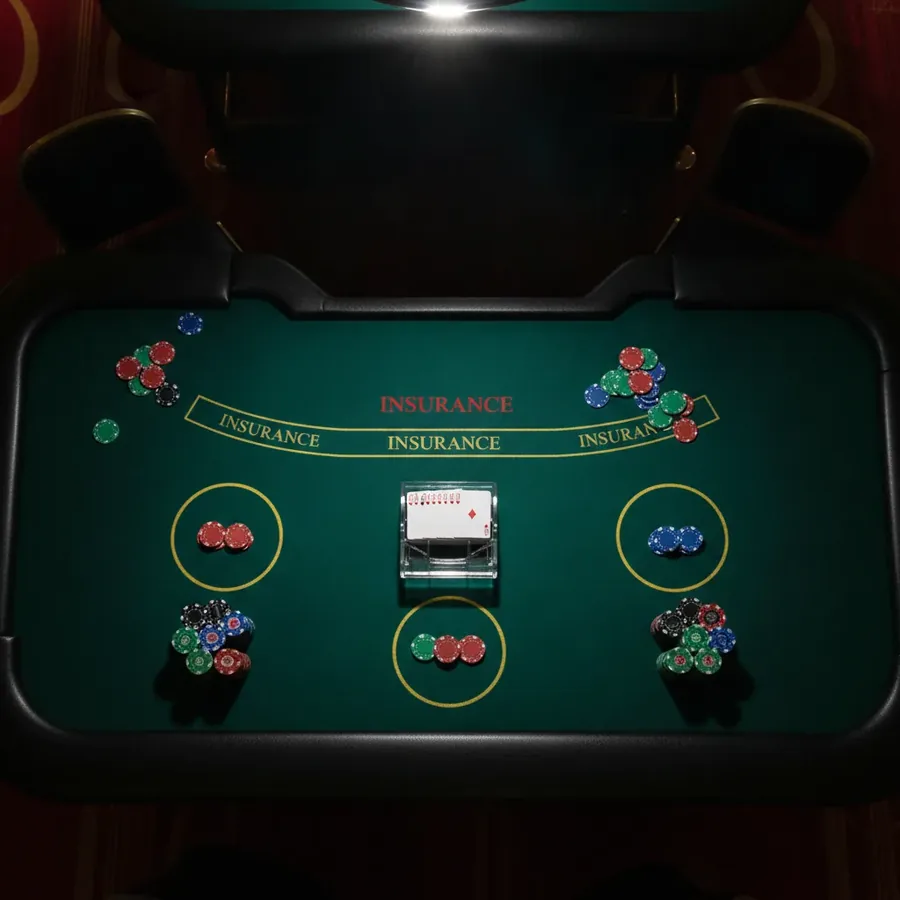
Blackjack Insurance is a side bet offered when the dealer's upcard is an Ace, typically costing up to 50% of the main bet. For a player holding a blackjack with a €1,000 bet, the dealer offering 'Even Money' is effectively the same as taking insurance. Even Money pays 1:1 on the player's blackjack, ensuring a €1,000 payout regardless of the dealer's hand. This is a guaranteed return on a strong hand. The RTP for this side bet is approximately 92.53%, with a house advantage of 7.47%.
The alternative is to decline Even Money and play out the hand. If the dealer also has blackjack, the player's blackjack is a push, and the original €1,000 bet is returned. However, if the dealer does not have blackjack, the player wins €1,500 (based on a 3:2 payout). The decision to take Even Money or not hinges on the perceived probability of the dealer having blackjack. For a player with a €1,000 bet, the choice can mean a guaranteed €1,000 or a potential €1,500 win versus a push.
Basic strategy dictates always declining insurance unless card counting indicates a true count of +3 or higher. In the context of Even Money, accepting it guarantees a €1,000 win on a €1,000 bet. Declining it offers the possibility of a €1,500 win if the dealer doesn't have blackjack, or simply getting the €1,000 bet back if the dealer does. For high rollers, the decision to take the guaranteed profit versus risking it for a larger payout is a crucial strategic choice.
Card Counting at Shuffle Master Table: why it fails
Shuffle Master tables, often employing continuous shuffling machines, render traditional card counting strategies ineffective. These machines constantly reintroduce cards into the deck after each hand or a small number of hands. For example, a €5,000 bet at a Quantum Blackjack Plus Live table, which uses advanced shuffling, would not benefit from a card count. The constant shuffling ensures that the composition of the shoe remains unpredictable, negating the advantage gained from tracking cards.
Traditional card counting relies on the principle that the removal of certain cards from the shoe skews the probabilities of remaining cards. When a continuous shuffling machine is in play, this dynamic is eliminated. The theoretical advantage gained by a card counter, which can be around 0.5% to 1.5% in favorable conditions, cannot be realized. This means a high roller betting €5,000 per hand would not be able to gain any edge over the house.
The RTP for Quantum Blackjack Plus Live is stated as 99.57% with optimal strategy, but this figure assumes a standard deck scenario. Without the ability to count cards effectively, the house edge remains fixed, and the player cannot exploit favorable deck compositions. Therefore, even with significant stakes like €5,000 per hand, the player is left playing against the inherent house advantage without any strategic mitigation through card counting.
Highroller from 500 EUR per hand
Quantum Blackjack Plus Live allows bets from 1 EUR up to 5,000 EUR per hand, catering to high rollers seeking significant stakes. This live dealer variant features Quantum multipliers that can reach up to 1,000x on specific 21 combinations. Such a broad betting range makes it suitable for players who prefer to wager substantial amounts on each hand.
For players who enjoy high stakes but with a slightly lower maximum, Lightning Blackjack offers a betting range from 1 EUR to 2,500 EUR. This game, provided by Evolution, also incorporates Lightning multipliers, albeit up to 25x on winning hands. The substantial upper limit still positions it as a strong contender for high rollers.
Blackjack Party, also from Evolution, has a maximum bet of 1,000 EUR per hand, which is lower than the other two live blackjack variants mentioned. While it offers a lively atmosphere with two hosts, its betting ceiling may be less appealing to the absolute highest rollers who typically participate in games with higher maximum wagers. This option might appeal to those who enjoy high stakes but within a more contained range.
Check table limit before the first bet
Understanding the table limits is crucial before placing any bet, especially for high rollers. For instance, Quantum Blackjack Plus Live has a maximum bet of 5,000 EUR per hand. Exceeding this limit means the bet will not be accepted, preventing unexpected financial outcomes.
Lightning Blackjack, another live option, has a maximum bet of 2,500 EUR. Players aiming to wager more than this amount per hand would need to find a different table or adjust their betting strategy accordingly. This limit ensures that players are aware of the maximum exposure per round.
Blackjack Party has the lowest maximum bet limit among the live blackjack games discussed, at 1,000 EUR per hand. High rollers looking to place bets above this amount will find this particular table unsuitable for their preferred betting style. Awareness of these limits is key to a strategic gaming session.
Double Down after Split: which tables allow it
Certain blackjack variants offer the strategic advantage of doubling down after splitting a pair, significantly impacting gameplay. Blackjack 6 Decks, S17, DAS, DOA with a 3:2 payout explicitly allows doubling after a split (DAS). This rule modification is beneficial for players who wish to increase their bet on favourable split hands.
The Blackjack Liberal Vegas Strip variant, known for its favorable rules, also permits doubling down after splitting (DAS). With a low house edge of 0.28%, this option, combined with other liberal rules like Split After Split (RSA) and Late Surrender, provides a robust environment for strategic players. The RTP for this game is a high 99.72%.
While not all blackjack variants explicitly list 'Double After Split' as a standalone rule, it is often implied or included within a package of liberal rules. The Blackjack Split / Double / H17 – Regel-Effekte indicates that DAS improves RTP by approximately 0.14 percentage points, suggesting its value to players employing advanced strategies.
Ignored Basic Strategy Chart: 1 Percent Wasted
Failing to adhere to basic strategy in blackjack can significantly increase the house edge, effectively wasting potential gains. For a Blackjack 6 Decks game with a 3:2 payout and a house edge of 0.46%, disregarding basic strategy could easily push the house advantage up by 1% or more. This means for every 100 EUR wagered, an additional 1 EUR could be lost to the casino.
The Blackjack Insurance / Versicherung variant, with a house edge of 7.47%, highlights the detrimental impact of deviating from optimal play. Basic strategy dictates always rejecting insurance, unless a true count of +3 or higher is achieved in a single-deck game, where the advantage can be around 5.88%. Ignoring this advice on a consistent basis leads to a substantial long-term loss.
Even in tables with a very low house edge like Blackjack Ein Deck at 0.15% with a 3:2 payout, ignoring basic strategy is costly. The theoretical RTP of 99.85% is achievable only with perfect play. Any deviation, such as making sub-optimal decisions on hard or soft totals, will erode this advantage and increase the actual house edge faced by the player.
Clicked Too Late: Hand Is Automatically Held
In live dealer blackjack, particularly in fast-paced games like Lightning Blackjack or Quantum Blackjack Plus Live, timely decisions are paramount. If a player fails to act on their hand within the allotted time, the system will automatically make a predetermined decision, often defaulting to 'Stand'. This automatic action is based on basic strategy, but it removes player agency.
The consequence of a late click in any live blackjack game, such as Blackjack Party, means forfeiting the opportunity to implement personal strategy. For example, if a player intended to hit a soft 17 but the timer expired, the hand would be held, potentially leading to a missed opportunity for a better score or an undesirable outcome. The betting limit for Blackjack Party is 1,000 EUR.
While automatic holding is usually based on basic strategy to minimize casino advantage, it overrides any player desire to deviate for specific reasons, such as a hunch or a complex card counting scenario. This is particularly relevant for high rollers who might be employing more advanced tactics and are accustomed to having full control over their bets and decisions up to 5,000 EUR in Quantum Blackjack Plus Live.
Contact
Live - online chat
Banking









Providers












UP-X Casino 2026